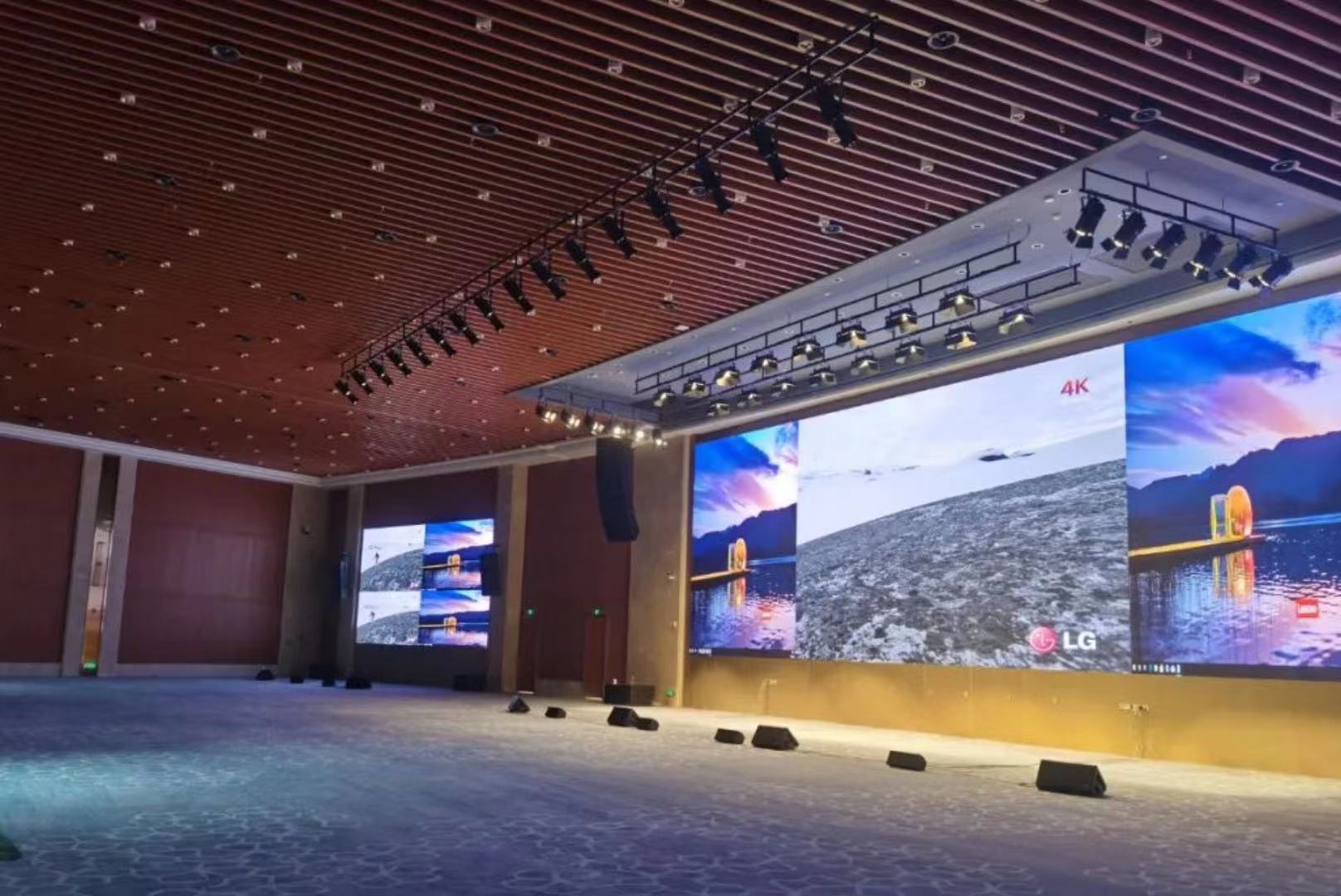
 The conference hall at the NanSha BinHai Exhibition Center in Guangzhou, Guangdong, features an irregular geometric layout with a rectangular cross-section. The distance from the decorated floor to the ceiling completion is 7.56 meters, and the hall spans 50 meters in length. The entire hall boasts an effective volume of 7,650 cubic meters, with a total surface area of 3,130 square meters, divided into three independent spaces by partitions. The first area has an effective volume of 3,760 cubic meters, with a total surface area of 1,680 square meters. The second and third areas both have an effective volume of 1,875 cubic meters, with a total surface area of 1,005 square meters. The primary function of the NanSha BinHai Exhibition Center's conference hall is hosting conferences while also accommodating lectures, forums, and exchanges.
To ensure the smooth functioning of the conference hall's primary purpose without interference, the designers developed a tailored acoustic design plan. In line with the specific requirements of the conference hall, the designers from TianGe Acoustics crafted a suitable acoustic design solution. They provided self-produced acoustic materials, including acoustic cotton packs, aluminum perforated sound-absorbing panels, Class A slotted sound-absorbing panels, and high-performance acoustic movable partitions. The original ceiling design incorporated decorative aluminum perforated panels. While aesthetically pleasing, these metallic materials had limited sound absorption capabilities, posing challenges for controlling reverberation time in the space. Therefore, a layer of 50mm thick sound-absorbing cotton was placed above the aluminum perforated ceiling, serving as the primary sound-absorbing material for the ceiling.
Acoustic treatment of the walls is a crucial aspect of architectural acoustic design. To meet requirements such as reverberation time and sound field uniformity, the walls within the space needed appropriate acoustic treatment. Slotted sound-absorbing structures were chosen for sound absorption treatment on the surrounding walls. This design significantly reduces echoes in the space, preventing issues like flutter echoes and howling, thereby improving the indoor sound quality. The slotted sound-absorbing structure consists of slotted sound-absorbing panels with a 50mm thick sound-absorbing cotton filling, leaving a cavity of at least 50mm.
Given the functional requirements of the conference hall, the entire space was planned to be divided into three independent areas using partitions as temporary enclosure structures. The conference hall requires high speech intelligibility, and the divided spaces need to meet specific requirements as well. Two sets of partitions were employed, taking into consideration acoustic needs. The partition surfaces have one side with a wood veneer finish and the other side with polyester fiber sound-absorbing panels, corresponding to the respective spatial areas.
 The conference hall at the NanSha BinHai Exhibition Center in Guangzhou, Guangdong, features an irregular geometric layout with a rectangular cross-section. The distance from the decorated floor to the ceiling completion is 7.56 meters, and the hall spans 50 meters in length. The entire hall boasts an effective volume of 7,650 cubic meters, with a total surface area of 3,130 square meters, divided into three independent spaces by partitions. The first area has an effective volume of 3,760 cubic meters, with a total surface area of 1,680 square meters. The second and third areas both have an effective volume of 1,875 cubic meters, with a total surface area of 1,005 square meters. The primary function of the NanSha BinHai Exhibition Center's conference hall is hosting conferences while also accommodating lectures, forums, and exchanges.