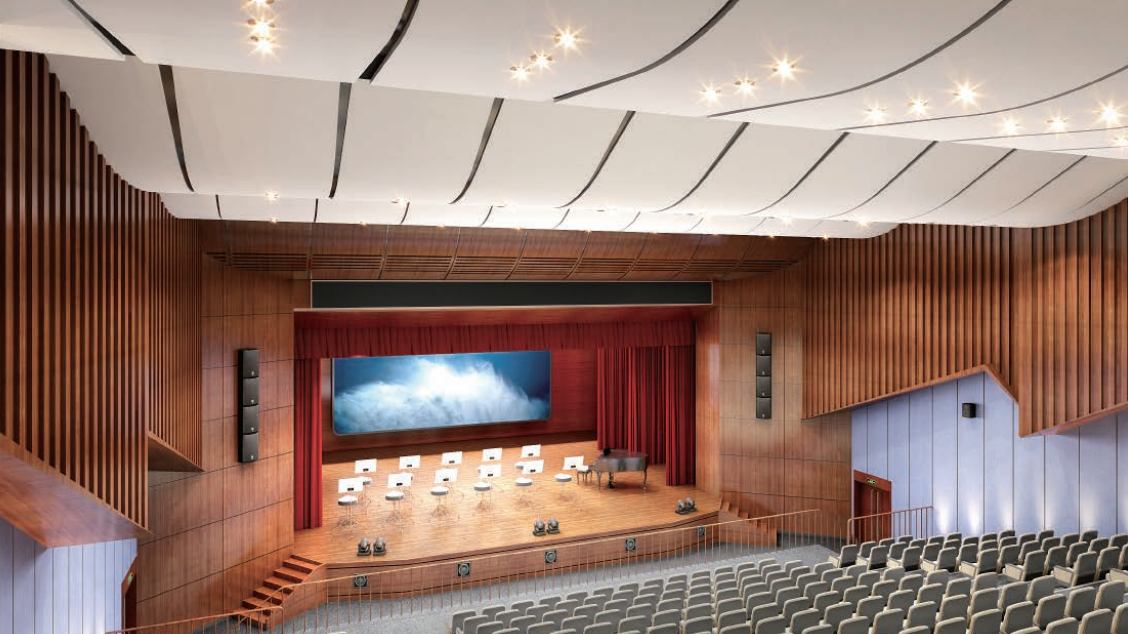
 Introducing our latest example of acoustic design using sound-absorbing materials: The newly constructed auditorium within Dongguan Hengli Mold Culture Center in Guangdong, China. Occupying an area of 1270 square meters, this exquisite hall is dedicated to hosting various performances. The interior decor of the auditorium draws inspiration from classical Chinese aesthetics, showcasing a harmonious blend of colors and materials, exuding an atmosphere of grand elegance while retaining a touch of intricacy.
Aligned with the acoustic needs of the space, the auditorium's acoustic design incorporates wooden sound-absorbing elements with perforated wooden acoustic panels, highlighting the beauty of the wood grain while effectively mitigating sound reflections. To further enhance sound absorption, sandstone acoustic panels are discreetly integrated at the lower sections of the walls, playing a crucial role in reducing indoor reverberation.
The perforated wooden acoustic panels offer a wide range of colors and materials, with aperture sizes and spacing adjustable to meet diverse acoustic and decorative requirements. Combining traditional decorative materials' thermal insulation, fire resistance, dustproof, lightweight, and non-decaying properties, these panels boast excellent sound absorption, high strength, impressive decorativeness, easy installation, and environmental friendliness.
The sandstone acoustic panels, also known as ceramic sandstone absorption panels (micro-perforated absorption panels), are crafted from carefully selected natural sand particles, bound together using cohesive materials to create a specific pattern of hard perforated micro-particles. Leveraging the principles of porous absorption materials and micro-hole resonance, the panels' frequency characteristics can be tailored by adjusting pore size, panel thickness, and rear cavity size, ensuring optimal sound absorption across different frequency ranges.
The acoustic design was implemented in various areas of Dongguan Hengli Mold Culture Center's auditorium, including the auditorium itself, lighting control room, screening room, preparation room, corridors, and rest area. The application of the aforementioned acoustic design scheme successfully controlled the reverberation time to an impressive 1.1 seconds, greatly satisfying the owner with the final acoustic and decorative effects achieved in this cultural center's auditorium.
 Introducing our latest example of acoustic design using sound-absorbing materials: The newly constructed auditorium within Dongguan Hengli Mold Culture Center in Guangdong, China. Occupying an area of 1270 square meters, this exquisite hall is dedicated to hosting various performances. The interior decor of the auditorium draws inspiration from classical Chinese aesthetics, showcasing a harmonious blend of colors and materials, exuding an atmosphere of grand elegance while retaining a touch of intricacy.